

Description
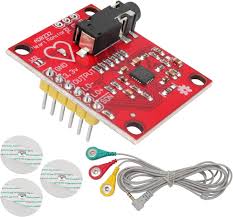
The AD8232 Heart Rate Monitor Module is a low-power single-lead ECG (electrocardiogram) front-end sensor used to measure the electrical activity of the heart. It captures weak bioelectric signals from the body and converts them into a clean analog waveform that microcontrollers can read.
It is widely used in DIY ECG projects, wearable health devices, fitness monitoring, and Arduino/ESP32-based biomedical systems.
KEY FEATURES
• Single-lead ECG / heart rate monitoring module
• Based on AD8232 analog front-end IC
• Measures electrical heart activity (ECG waveform output)
• Low-power operation suitable for wearable devices
• Leads-off detection (LO+ / LO−) for electrode safety check
• Built-in instrumentation amplifier with filtering
• High common-mode noise rejection (reduces body motion noise)
• Analog output compatible with Arduino ADC pins
• Supports 2 or 3 electrode configuration
• Compact breakout board design with electrode connectors
• Real-time heartbeat waveform visualisation support
SPECIFICATIONS
• Product Type: ECG / Heart Rate Monitor Module
• IC Used: AD8232
• Operating Voltage: 2.0V – 3.5V (typical module: 3.3V)
• Supply Current: ~170 µA (low power consumption)
• Output Type: Analog ECG signal (to ADC input)
• Filter System: Integrated high-pass & low-pass filters
• Gain: ~100 (internal signal amplification)
• Common Mode Rejection Ratio: ~80 dB
• Lead Configuration: 2-electrode or 3-electrode system
• Electrodes: RA (Right Arm), LA (Left Arm), RL (Right Leg)
• Leads-Off Detection Pins: LO+, LO−
• Operating Temperature: -40°C to +85°C
• Interface Pins: OUTPUT, LO+, LO−, SDN, 3.3V, GND
• Board Size: Small breakout PCB (varies by module)
• Application: ECG monitoring, heart rate tracking, fitness devices, medical prototypes

Reviews
There are no reviews yet.